
Archive for the 'Work Shops and Seminars' Category

Squid’s First Obedience Seminar

Saturday and Sunday was Squid’s turn to work with Maria Hagström. Squid did really well and I couldn’t be more pleased with her! She stays in her open crate while other dogs are working and I am engaged in other activities. People with dogs have been passing her crate and giving her cookies for staying calm. Not once did she show any of the resource guarding behavior that I have seen before. She was all happy and wagging her tail. We did a lot of proofing on focus and sit stays on Saturday. And worked on stimulus control.

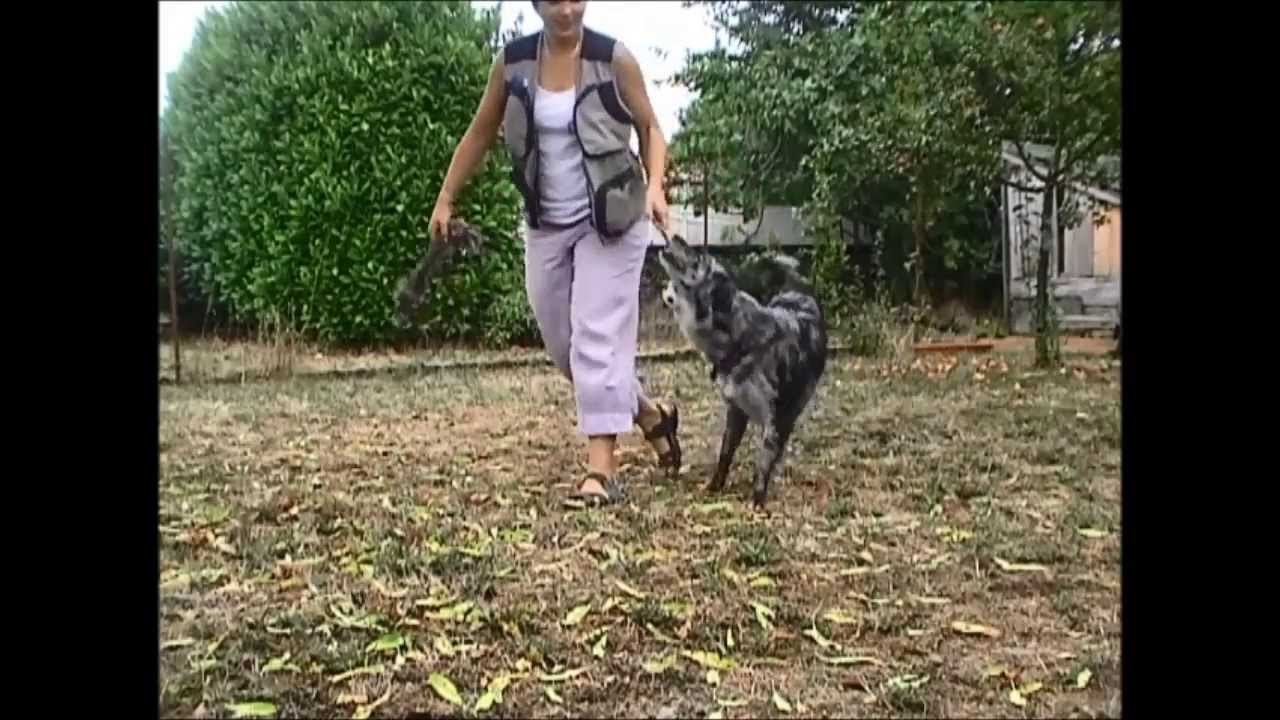
On Sunday, Squid got to do her first sequence in a trial like setting and we worked on the first part of a trial - entering the ring and getting ready for the first exercise. In our last session, we worked on heeling. Here is a video of some of the training from yesterday. As a bonus, I included some of Shejpas dogwalks from lunch:

Greg Derrett seminar

We’re back from more than three days with Greg Derrett in Malmö, Sweden. It’s so much fun and the fact that I probably won’t be able to work with Greg until next December is pretty depressing. We’ll try to get some other intructors to come before that. Monday night was a lecture on the system. It’s always great to hear it again and to hear the new stuff that is going on in the system. And to be able to ask all the theoretical questions we’re always coming up with…

Tuesday started with some ground work. I ran Missy, to show that her circle work actually is pretty perfect even though it doesn’t always look like that on equipment… It was really good. We then did some two jump drills and my dogs were really showing off their worst sides. Missy was crazy and bar-dropping. Shejpa was sniffing and shutting down after a few runs. Some of it was probably my fault, it’s just like Shejpa’s first trial. I love running agility under pressure so much that I get too excited. I want to run fast, get to positional cue as fast as I can and I’m not patient enough on my rear crosses. I alternated wich dog I ran. On Wednesday, we did sequences with jumps and a tunnel. I ran Missy some in the beginning, and it was really better when I tried to think about being calm and just flowing instead of rushing. I have no problem getting where I need to be even if I’m not running away from my dogs. She was still dropping quite a lot of bars. Some of it is handler error, some of it is that Missy can’t handle my acceleration. Greg told me to do a lot of speed circles with 90 degree turns with her. Shejpa was a lot better and I ran her all afternoon. Greg concluded that: “She does have her moments of brilliance”.

We finished yesterday with a test on contacts and weaves. I was a bit nervous to try our running contacts on new equipment and under pressure, but Shejpa was just perfect. The proofing test we did on the dogwalk was stopping half way and she hit her contact below the last slat. A-frame is never a problem, so I didn’t worry about that. Seesaw is definatly a problem at times, but with just that one obstacle, she was alright and Greg was pleased. Weaves were good, Shejpa was the only dog that passed all the tests on weaves, and her time was much better than I thought it would be. We get a lot of nice comments on our weaves, but I’m not entirely pleased with them, so the plan is to retrain her with 2×2 (but I’ve said that for a long time…). 2×2 is a brilliant method and Thomas dog Pavlov has the best weaves with almost no training and he’s the only dog that has been taught with the 2×2s.

Today was about running courses, and I ran Shejpa all day (we only got through three courses). She was even better today and when she is focused and running, she really is brilliant. I think she could still get a lot more speed, but I do struggle to keep up with her sometimes, so I think she’s pretty ok. She had better turns than I thought she’d have and she is very responsive to my handling. First course was the individual small standard course from world cup (as it is on paper, not the actual course that you can watch on YouTube, they differ a lot). Shejpa was great and I manages to get us around the course fine (rewarding her seesaw). I got into position for front cross after the dogwalk and was even able to decel and be stationary and front cross as she met criteria. Contact was perfect. Next course was a pretty tricky jumpers course that was fine, apart from some footwork on my part. And the last course (wich, surprisingly enought also was a USDAA masters course!) was really easy and all about running.

Here’s a video with Shejpa running all three courses with Greg’s comments in the background.

About my handling then… I seem to have good footwork, good timing and I can run pretty fast. Most of my mistakes comes from not having enough patience. I need to work a lot more on handling with both dogs, really getting to the point of “meditation in motion” that Greg was talking about. Where you just flow around the course and also really know your dog. Missy needs a lot of work on speed circles and double box. Both dogs need to drive better to a jump before a rear cross. Shejpa needs more drive on lead out pivots, I feel that she is slowing down, especially on the harder ones.

It’s good to be home

I had a very good time teaching in Edmonton, but it sure is nice to be back home and able to train my own dogs. I have trained a lot with both Shejpa and Missy today. We went to a new club i the morning to try our running dogwalks on a new kind of equipment (aluminium frame with carpet). My dogs have only done their running dogwalks on our wooden dogwalk at home. I was surprised with how it didn’t really seem to matter. Even Missy, who usually isn’t very confident, ran it fast and consistent right from the second attempt. Shejpa was even better and showed great understanding even when she slowed down a little (she is always best when she is really fast). Shejpa also got to try a new seesaw. She isn’t doing the whole seesaw yet, but she is learning fast and we should be able to do the whole thing in a couple of days. She shows great speed, weigh shift and targeting.

We did some more training later in the afternoon. Both dogs got to do some jump grids. I introduced Shejpa to the long jump and put it into her distance grid later. She had no problems with it, so I will put it into sequencing pretty soon. I also introduced a pole in the ground to help her turn after her running contacts. It might clarify things for her, so I will give it a shot. Justine had tried it with Preston and it looked great. I might try it with Missy too, although she seems to have more understanding of the turns and will think more than Shejpa. I did some shaping with both dogs in the house as well. Missy now knows how to jump into my arms when I stand up (Thanks J!) and both dogs did shaping sessions on the theraball. They have amazing balance and strenght!

Thanks to Justine and all the nice people I met in Edmonton. I had a great time and it was really interesting to see dog training from new perspectives. It was fun teaching european style obedience to an enthusiastic crowd of dogs and owners. I hope that they will keep up with the tugging and high speed training that we did. It was also fun to do a puppy day and I am looking forward to getting my next puppy. Handling is always one of my favourite things to teach and I was happy to see so many that were dedicated to doing agility within Greg Derrett’s system of handling.

Handling with Laura Derrett

I really should write here more often, but we have loads to do all the time. We came home from our honeymoon a week ago (after 20 hours of waiting in the most awful airport ever). Then Laura Derrett came on Monday and we’ve had four days of handling with her. She left yesterday and I was once again just exhausted from running two dogs, taking care of people and staying up a bit too late drinking beer with Laura. Tomorrow is qualifications for Norwegian obedience nationals and I should be out training Missy (better late than never?) but when I do we just end up running agility instead. I don’t really feel motivated for obedience right now. If I’m lucky, we’ll qualify for the finals on Sunday, but I’m not counting on it. We should have trained more, but with the wedding and having both Justine and Laura here, obedience has not been a priority. I should also make some videos of obedience training because I leave for Canada on Monday and will teach obedience in Edmonton next week.

Having Laura here was great! Both my dogs surprised me in a very good way. I ran Missy the first two days (double box) and both dogs in the last seminar that was more advanced. Missy has made such an improvement since Justine was here. I havn’t done a lot with her, just her running contacts and some collecting and turning over one jump. But she was like a new dog and for the first time I really enjoyed running her! She didn’t knock any bars unless I did something stupid and she could even keep the bars up in serpentines. She could collect and dig in when I was stationary in a sequence, something she’s never done before. We still have a lot of work to do, but I finally feel like we’re getting somewhere.

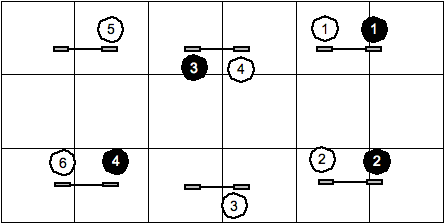
Shejpa was suprisingly focused through both days. I always obsess over her speed and think that she’s slow, but videotaping and actually timing her made me think differently. She was acutually 0.5 seconds faster than Missy over a six jump sequence. That’s a lot! She was 0.3 seconds slower than Ted (genius border collie who is really powerful) in the sequence with two serps and I slowed her down on when I didn’t get out of serpentin position fast enough. I guess I should be happy with her speed, but there are still things that could be a lot better. She responds nicely to my handling, but she could be faster on arm changes. Maybe I don’t reward them enough (thinking about it, I very rarely reward front crosses) or maybe I’m sometimes early? I don’t know, but she blind crossed me and took white number 3 in this exercise when we ran black numbers and were told to just front cross and leave on commitment to 2:

She also blind crossed me in a front cross in the video, but I was babysitting the turn so that she was just turning wide. Anyway, it’s very good to know and will be the focus of my handling training this weekend. Her response to my decel is getting a lot better, but I will need to work on a verbal dig cue and also on her responding to my decel when I’m behind her. I also think that I need to work on decelerating in a rear cross to make them really tight, I’m not sure of how to do that.

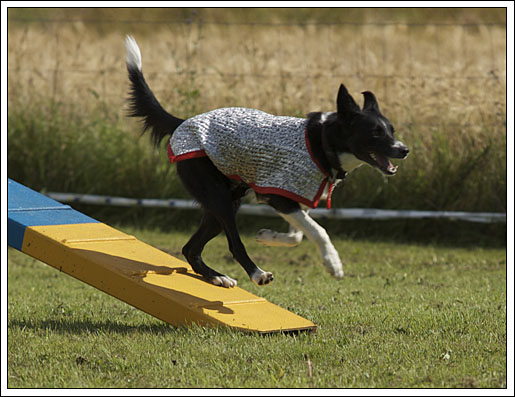
I had to try some dogwalks now that I hadn’t been training at all in over a week. Missy was really good and consistent when I ran her straight. Laura timed her to 1.25 s. and I also had some really nice turns off the dogwalk where she really dug in on the yellow and had a nice, tight 180-turn off it. We’re unfortunatly not done with turning of the dogwalk, sometimes she’ll completly jump off to the side, but I had a nice session with her today where she turned nicely. Shejpa’s dogwalk was not as good as Missys on Tuesday when we started training it again, but she’s really come along nicely and I had a session today where we worked on turning and she was almost 100% when I sent her to a person with food that moved more and more to the side (almost to 90 degrees). I also started working on her seesaw again and it’s looking pretty good.

Here’s a video of mosty Shejpa from Wednesday and Thursday:

I’m really happy that we got both Justine and Laura to come here and teach for us. It has been so much fun and people seem really happy. I hope that they’ll come back next year. I’m seeing Greg in Malmö in Decmber. I look forward to that.

Missy is running her contacts as well!

Justine Davenport has been here for four days teaching and we’ve had a great time with lot’s of training for the dogs. Justine did four days of handling (one day flatwork, one day double box, one day rear crosses and one day of running courses). It was really good and I think everybody was extremly happy. I’m to tired to write a lot right now, I have to come back to some of the things that I learned and did. Shejpa has worked a lot on her running contacts in the evening. She’s good when she can run straight after the dogwalk, but we still have to work through different angles coming off the dogwalk. I guess it’s just something we have to work on, like how you gradually raise the plank and add handler motion. She is making progress.

Missy started her runnig contacts training on monday night. We started with a plank on the ground. Yesterday, we added height and raised the plank a bit. And tonight, Missy was running a full height dogwalk. Missy is easier to train than Shejpa in many ways, and I’ve learned a lot from teaching Shejpa. But I never thought we would come this far in two days! We obviously still have a lot of work to do, but I’m very pleased with us both so far :) Here’s a video of our first session on a full dogwalk:

Jump workshop

We have been to a two-and-a-half-day workshop on jumping with Vappu Alatalo. Vappu has trained with Susan Salo and is teaching her stuff. This was an advanced workshop for those who went to a workshop in February (wich I didn’t because I was in Florida, but I sent Thomas with Missy). Missy was a superstar in the Februray workshop and she has been doing great at home as well. Shejpa, on the other hand, has been hopeless and just really sloppy and crashing through the grids at home. I really didn’t know what to do with her. On the other hand - Shejpa has been jumping all right when we have been sequencing and Missy has knocked a lot of bars, so I didn’t really know what to think and god pretty frustrated with the whole jump training.

It’s good to attend a workshop when you’re confused. I have learned a lot this weekend! Doing more advanced grids has given me a lot more understanding of how to bridge the gap between the basics and running sequences. I love working with jumping because it brings out functional, harmonic movements and because I get to train my eye and really watch dogs move. When I got home and watched some old videos of my dogs doing agility, it was like watching them jump in slow motion. I saw so much more than I used to! I am convinced that doing this kind of training is both good for performance on course, but also to keep dogs fresh and healthy throughout their career. Not everybody here agrees with me on that.

Shejpa started the workshop with a basic grid in her usual style - sloppy and crazy. But we acctually found out why she has gotten worse and worse at home. It’s too easy for her to do the same old basic stuff all the time. She gets sloppy when there is nothing for her to thunk about. She was a different dog when we changed some things and gave her challenges. Vappu was very impressed with her and thought she was a great agility dog. Shejpa did all grids in a nice way, but often failed on the first attempt and then changed and did great the second time. This is what we’re going to work on. Give her different grids and wait for her to start doing it right from the beginning. I think it’s important to not give her the same thing again if she is successful. She will get nonchalant and not do as well. I need to change something (visual appearance for example) every time she has been correct. I have also thought that Shejpa sometimes doesn’t extend well in her rear when she’s jumping. Vappu said that she did extend, but that her personal jumping style was to pull her hind legs early to prepare for a fast take off when landing - and that that style was fast and not problematic. Sounds nice.

Missy is still jumping well, but she needs a lot of proofing when it comes to my movement. She was more extreme than she usually is at home and reacted a lot to any movement from me. This is probably the biggest reason why my nicely jumping dog is knocking a lot of bars when we run together. This will take a lot of time to fix, but I feel that I have better understanding now and that I feel motivated to do something about it. Both my dogs need more work on distance grids as well. I have hardly done any with them and it shows.

I am very happy with how well my dogs are using their bodies and how well they kept fresh during three days of training. The dogs get so tired from this kind of training that you almost can’t believe it. But my dogs handled it well. Warming up and cooling down two dogs gave me a lot of excercise as well - about two hours of walking every day. I was more tired than them after the work shop ended on tuesday.

Canada in a short summary

We’re back home after ten intense days in Canada. We learned a lot and made new friends. Shejpa is a great dog to travel with. The vet at the airport in Norway even asked if she was on calming drugs, because she was just sleeping in her crate while we were waiting. I guess a lot of dogs are more worried about flying and waiting at airports.

The first two days was Greg Derrett’s master camp and I was just watching. It was very interesting, but you get more confused the more you learn, that’s for sure. Greg and Susan does not agree on everything and that leaves me in a spot where I have to make some descisions… I left Greg, Susan and the rest of them on their own on the third day, because Shejpa and I got a spot at Laura Derrett’s work shop. It was fun to run, but Shejpa got tired very quickly in the hot weather. It doesn’t look too bad when I watch the videos, but some runs felt like she was jogging. I think I did a pretty good job though, and sometimes it’s better to be slow and correct (as a handler learning) than to do it fast and sloppy.

Greg and Laura went back to England and we carried on for four more days with Tweener Camp. We did a lot of things and Shejpa was mostly a good dog with quite a lot of drive. She liked the sheep skin tug toy and we bought a few nice toys to bring back home. I tried them on Pi today and she was thrilled. We did quite a lot of work on the nose touches, but we didn’t come as far as I had hoped. I realized that we weren’t quite finished with fading the target and worked a lot on that. She’s generally good when I take the target away after one or two repetitions, but when we start with no target, she’s uncertain on where to put her nose touches and tends to curl into me on the stairs. We made great progress and one of the things we did was to place lots of targets around the stairs, but out of her reach, to proof that she was targeting straight anyway.

Shejpa relaxing in her crate

We also worked a lot on a hot target discrimination (much like the one you do at chicken camp). I chose quite difficult objects that rolled away if she wasn’t thoughtful and controlled. I liked that idea, but I guess it slowed us down a bit. She indicated the hot target (chapstick tube) by laying down with the target between her front legs. I thought the discrimination part would be easy, but Shejpa behaved much like the chicken at chicken camp - throwing themselves at a target that you drop or peck at. We did work through it and I think it was a great experience for both of us. Shejpa really needs a lot of shaping (wich I have neglected with her) and challenges that forces her to be more thoughtful. Some people will tell you that shaping makes dogs frantic and stressed, but I would say it’s the other way around if you do it right. Shejpa is getting more and more calm and thoughtful for every session of shaping.

Susan and DeCaff
Susan and DeCaff

Bob Bailey came to Say Yes on the last day. We were eight people (mostly Susan’s instructors and Susan her self) working our dogs and talking (a lot of talking, really) with Bob helping out. It was a great experience and I’m very thankful for being invited! I also drove Bob to the airport and got a chance to really talk to him about the 80% rule that has been kind of misunderstood in Scandinavia. I got great information from him. This is my own summary of what he said (and I hope I got it all right):

- When the animal is successfull 80% of the time, you should raise your criteria.
- It’s a common misstake to not challenge the animal enough in training
- 90% success is definatly a misstake
- You need to re-think and make a new plan if you’re not progressing (not getting a higher percentage of correct responses) in three consecutive sessions.
- You need to re-think and make a new plan if you’re getting worse (getting a lower percentage of correct responses) in two consecutive sessions.
- You shouldn’t worry about not getting 80% success as long as it’s getting better and better, but don’t raise your criteria until you’re getting closer to 80%.
- How low your success rate can be is dependent on if the animal still thinks it’s worthwhile to keep trying. Bob thought that 50% was kind of a limit for a lot of animals.
- These principles are worked out by gathering data from a lot of training sessions with a lot of different animals and it worked great for Bob and his trainers.

You can fins lots of pictures from our trip in the gallery (click on “photos” above). I’d like to thank Susan for another fun trip across the Atlantic and Justine for being a great room mate. Also, congratulations to Justine, Lynda and Susan for making the FCI world team!