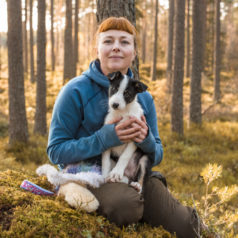
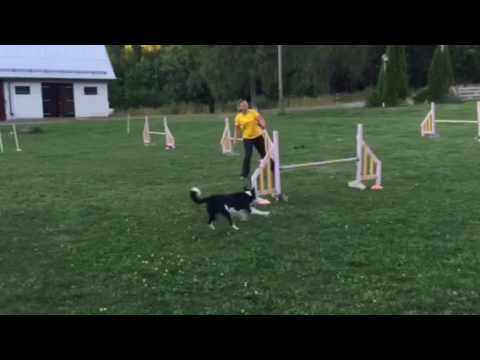
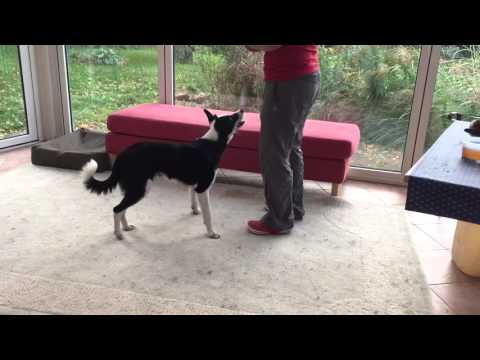
It’s been a while since I had a puppy of my own to raise and train right from the start. I’m so excited and I want to share the journey – this time in the form of a YouTube series.
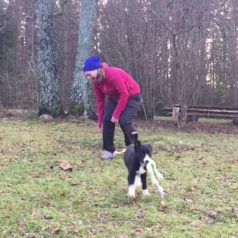
First episode. About Spam, how I picked the puppy and our first training sessions.
Second episode. Spam 9 weeks old. A few adventures outside the farm and more training.
Third Episode. Spam 10-11 weeks. Training on rear end awareness, backing up onto things, toy play, and sits.
Make sure to subcribe to my YouTube channel so that you don’t miss upcoming episodes.
Epic is finally back in agility trials, almost ten months after his caudal cruciate ligament tear at the beginning of February. His recovery has gone great, but I’ve progressed slowly through the summer and fall. He’s eight years old now and recovery and rehab can be slower than in a younger dog. We’ve mostly worked on walks in the woods, strengthening exercises and some jump grids. I’ve been afraid of letting him go back to “real” agility but finally decided that I just had to do it and entered him in a competition. We ran three jumping courses on Saturday and it felt so much better than I expected! After the first run, I could relax and just enjoy the moment. Epic was so incredibly happy to be back in competition – it was stunning to see how he really enjoyed everything about it.
The first run. He dropped a bar and then took an off-course jump.
The second run was my favorite. He took the wrong tunnel entry on #4 – I did suspect that what works for Bud doesn’t for Epic right now. He turned into me when I was behind instead of staying on the narrow, straight line to the left tunnel entry. The rest of the run was really nice. I love how he nailed the independent part into the weaves.
The third run was clean, but I think he lost some time in the last tunnel. It’s almost not discernible in the video, but in real life, I felt that he got stuck and I had time to think all kinds of terrible thoughts on how he would come out of it on three legs, or not come out at all…
Bud also competed and won the first class. We had so much fun and I’m looking forward to competing again on Sunday!
I’m at home for a few days in between Norway trips. Last week, Bud flew with me to Tromsø to teach for a couple of days. We had a great time. From there, we flew to Oslo and traveled south to Fredrikstad, where there was a trial with some interesting judges. Bud won A3 on Saturday and became Norwegian Agility Trial Champion. He also qualified for finals but popped out of the weaves in the final run. Tomorrow, I head for Stavanger on the Norwegian west coast. No dog with me this time, so I’ve tried to spend a lot of time training and conditioning my dogs while I’ve been home. We made a video where you can see some of the skills taught in the Agility Handling Foundations Online class starting on September 3rd. Let me know if you have any questions about the class. And please leave a comment and tell me what you’d like to see a video on next.
Summer has been very hot and very busy. Last week I published a video where I show how I teach a jump cue for agility (and why it’s important). I hope to find the time to do more instructional videos and that you enjoy it! We’ve also published two online classes this fall – Foundation Class and Agility Handling Foundations. Both start on September 3rd, so sign up now if you want a spot!
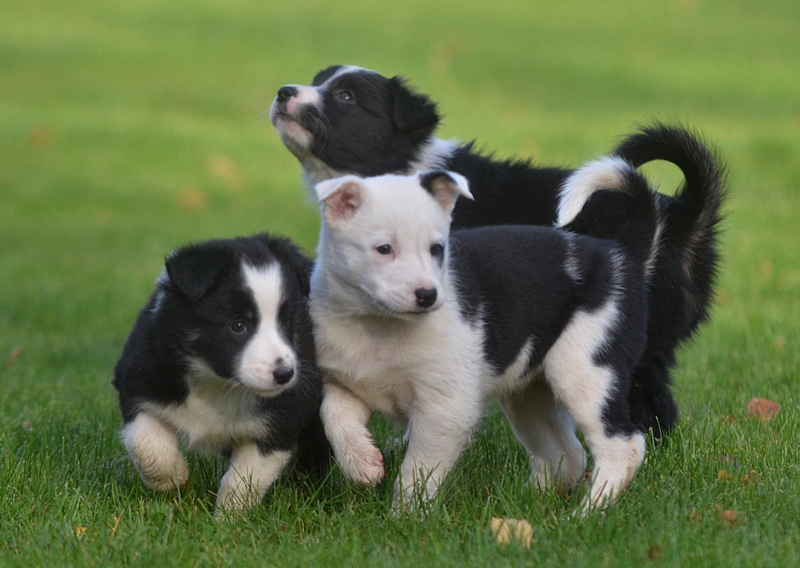
The three girls got their very first training session today. I’m not sure if you can call it training, but I played with them for a few minutes each. Of course, they have been playing with me a bit before, but nothing planned. All three seemed to enjoy playing. Holly is the most intense and most interested in toys. Ivy is more socially interested and really wants to cuddle. Fern is somewhere in between. I’m very excited to try a shaping session with each of them too, to see how they might be different there. The only “training” I’ve done is to let them eat some treats from my hands (puppies don’t really understand that concept until you show them).
They are 10 weeks now and obviously I haven’t done much training with them. I usually think talking about “puppies being puppies” is strange (what else would they be?), but that’s really what they have been until now. Just three puppies exploring the environment, playing with each other, interacting with the older dogs and sleeping in a pile.
The dogs and I went to Mora this weekend for agility competitions. I was just going to run Epic and Squid in class 3, but last week I asked if I could do a late entry and run Bud in jumping class 1 on Sunday morning. I feel that Bud is more than ready for class 1 handling, but he needs more work on some obstacles. My goal with him has been to be very well prepared for his first trial, so in that sense I failed. The first run of the day had both the tire and the flat tunnel in it, and I did not feel confident that he would do them on the first try if I was running normally. The tire was obstacle number two, so I could help him get that right and he did also do the flat tunnel on the first try (but with some hesitation). I guess we can consider it a good training session for the future. He dropped a bar on a tight turn out of a very fast line. I think I was a bit behind and maybe not as clear as I should have been.
The second run was with just tunnels, jumps and weaves, but with much more handling. It suited us better and I was very pleased to feel confident that I could handle him the way I would have with one of the older dogs. He was clean and fast enough to win the class! He behaved nicely before and after his runs and seemed to enjoy finally getting to run and not just watch others at a competition. Now we’ll train for another month before his next trial, where he’ll also get to try standard agility.
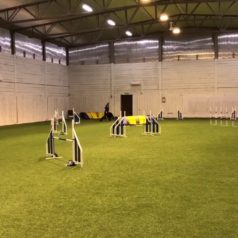
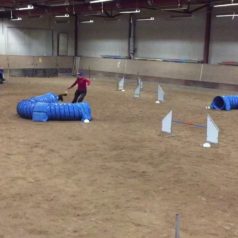
It’s November already, and unfortunately winter came early this year. It’s snowing, so my agility equipment is covered in snow and sheep have had to move indoors for the winter. Winters in Sweden can be really depressing, but I’m a bit more optimistic this year as we’ve got a new indoor agility facility just 15 minutes from home. I do some training on my own there, teach class once a week and train with friends every two weeks. Here are some clips of Bud from training with friends yesterday. Things are starting to come together. He’s responsive to my handling, jumps nicely, weaves with confidence, and did his first A-frame in a sequence yesterday! It looks like he’s figured out how to run it without flying too far over the apex (another “let the dog tell you when he’s ready” situation). We still have a lot of things to work on (like that weave situation that he didn’t understand, and always jumping the tire/wall jump/spread, and consistently doing perfect seesaws, and…), but we’re having so much fun getting ready for his first competition in December.
Bud’s five little sisters were born 8 weeks ago. They are absolutely adorable and so much fun. Two of them will move to new homes this week, and three will stay with us – at least for a while until we know more about them. I’m very excited to see how they will turn out. Raising puppies is a lot of fun, and a lot of work. I believe the most important things in raising good puppies is good genes. No amount of socialisation or stimulation will make up for breeding from nervous dogs. And puppies with good genes generally turn out really good even if they are raised with just basic socialisation. I’m not afraid to buy puppies from working farms in the UK. If it’s a good dog, it will turn out just as good as any dog from a breeder here.
What I think is important, and what I make my priority with my puppies, is that they get a lot of time outdoors where they can move, play and explore without restrictions. Where they are not slipping on slick floors and where they develop balance, proprioception and confidence. My puppies spend most of their days from 4-8 weeks playing and exploring (and sleeping!) in our garden (yes, even in the snow). I also make sure to let them meet as many different people as possible, including children. They get to hang out with their mother a lot and also with the other friendly or neutral dogs in the house. They get fed mostly raw, but also tries different kinds of kibble and other types of food. I’m convinced that Early Neurological Stimulation and things similar is pseudoscience, and while it probably doesn’t hurt it’s weird how many people will value that kind of thing over other many much more reasonable criteria for picking a breeder.
Bud is now 19 months and we’re having a great summer where his agility skills are coming together. There are so many exciting first times. I think I start most things a bit later than other people. It’s easy to get stressed out by all the younger dogs running courses at full height when your young dog is still working on foundation skills.
Bud has been very keen to work and easily excited all his life. But he has also been immature and easily excited also means easily frustrated if he doesn’t understand. I’ve had to teach each skill to fluency before putting skills together in a sequence. Lumping doesn’t work well with Bud.
I’ve also been reminded of the importance of letting the dog direct the pace of training. If something is not working, it’s often a good idea to not push it, but rather work on other things for a while. There are so many things that just didn’t feel right – he didn’t like them, or he didn’t understand. So I waited for a while and when I came back to it a few weeks later he could just do it, and he wanted to do it.
Bud has been jumping 40-45 centimeters for quite a long time. He did not seem ready for higher jumps and I was getting a bit stressed by it, but didn’t push it at all. Then last week, he jumped 55 centimeters on his own a few times (when just running around on the field at home). I tried to ask him to do it, and he did! And then he was able to run a fairly complex sequence with jumps on 55 without hesitation. He is still figuring out his jumping, but I’m very pleased with that he is thinking and trying his very best.
I started his weave training a couple of months ago. We’re mostly using a channel method, with some 2×2 thrown in. Things were going well until I started to close the channel. He seemed frustrated and couldn’t really do it. I tried to use guide wires because I know a lot of people are successful with the combination of channel and wires. This was very entertaining to watch, but gave me more problems than I already had. So we just stopped weave training for a while instead. This week, we’ve started our weave training again. I started with a fairly open channel, reminding him of all kinds of entries and staying in the weaves with different handling and distractions. I’ve now started to close the channel again, and everything is different. He is much more happy, much more confident and his body seems to flow in a much better way.
A third example is our running contacts training. We started about five weeks ago with a plank on the ground and he has been a joy to train. He really seems to get it and we’re having a lot of fun with proofing and teaching turns now. The only thing that has been difficult was to get rid of the thin and broad plank I used on the down ramp to smoothen the edge for him. My dogwalk has a pretty high edge at the end of the contact, and it gets more pronounced when the dogwalk is low. When I tried to take the plank away he’d have one nice hit and then it would fall apart and he’d avoid the low hits. So I didn’t take it away any more. I kept it there for a few more weeks, and then I tried to take it away again a few days ago. Now he didn’t have any problems and I think I can put the extra plank away and not take it out again until I’m training a new dog.
I’m very happy that I’ve had the patience to wait until Bud has told me that he is ready. It doesn’t mean that we haven’t been training – we’ve just trained other things (and you can never get too much foundation training). I think that a lot of problems can be avoided if we’re not pushing dogs beyond their comfort zone and if we allow them to mature. Every dog has their own timeline. I love training with Bud and I’m very excited to see him transform from my little puppy to a skilled agility dog. I’m not in a hurry to compete with him and he still has a lot to learn.
Here’s a video of to “firsts” from this weekend. His first sequence on large height jumps, and his first session on full height dogwalk with no plank.
Last weekend was the tryouts for the Swedish WAO (World Agility Open) team. We two jumping and two agility rounds on Saturday, and the two best results (points based on faults + time in relation to the winning round) counted in team selection. Squid and I started with a great jumping run, but unfortunately with one bar (all jumps on 65 cm which is higher than we usually compete on). Then we ran a great agility round – but with one bar again. No points for us, but we still had a chance if both afternoon runs were clean. We started with agility in the afternoon, and I opted for a very conservative run with some bigger turns to save the bars. It worked! We came second, but the dog that won was very fast (good lines, running dogwalk), so we only got 27,30 points. The winner gets 50 points, if you’re one second behind you’ll get 40 points, 2,5 seconds behind is 25 points etc. A fault added 5 seconds to your time, so there was a theoretical chance of points if you were more than 5 seconds faster than the winner. In the last run I had to go all in to set a better time, and we managed to do it! With 47,30 points in the last run, we actually won the tryouts and will be going to England in May to represent Sweden. I’m very happy that at last, luck was on our side.
On Sunday, there was a games competition just for fun. And it was a lot of fun. I love snooker, and we were the only 560 dogs that got 51 points! Squid managed to win the combined (snooker + gamblers) competition, which felt great considering we will be doing games at WAO.
I love England and hope to be able to be away for a couple of weeks so that we can combine WAO with herding and sightseeing.
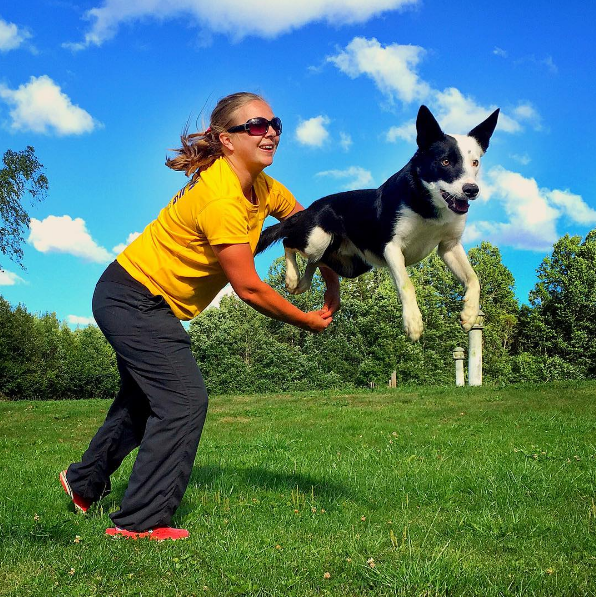
Bud learned the jumping stand early. I like to teach it to small puppies because they are bouncy and you can often easily capture it by just standing and waiting for it to happen when the puppy has energy and is playful. I don’t care a lot about perfection at this point, I just click and reward any bounce where both front legs leave the ground until the puppy offers the behavior in order to get a reward. I also like to name the behavior early, because I think it’s good to work on stimulus control with my puppy, and they often learn to love this behavior quickly.
I have not planned for Bud to be an obedience dog, but I love to work on obedience behaviors and think they are great for anything I want to do in the future. I’ve used his jumping stand for cue discrimination, and I have added some staying in position after the jump too. But I haven’t really worked on it, and I realized recently that he always moved his back feet counter clockwise on landing. It wasn’t pretty, and he did it every time. And I had rewarded it every time. Now, I decided that I wanted him to stay straight infront of me when doing the behavior, maybe even be able to keep his back feet still and just bounce with his front feet.
If the dog is always performing the behavior in a way we don’t like, it’s not a good idea to just not reward it and wait for perfection. The dog will probably give up in the process. You could chose to reward the better responses, and not reward the ones where he moves his feet the most – but you’re still rewarding something you don’t really like. Another solution is to think about some other behaviors to train that might help with understanding and hopefully bleed over to the behavior in question. That’s what I started by doing. I worked on backing up straight, offering a stand (not a jump, just four feet on the floor) straight infront of me and some rear end awareness and finishes on my right side (moving back feet clockwise).
This helped enough for me to get much better behavior once I started the jumping stand again. There were a lot of offered jumping stands that I didn’t reward, but he did seem to remember the exercises we’d just done when I didn’t reward, and I could jackpot some jumping stands that were much straighter than before. I still rewarded back foot movement (which I don’t really see as a problem) as long as it wasn’t to his right. If I found that he reverted back to his old style, and rate of reinforcement got too low, I would remind him of one of the behaviors used before (often just standing in front of me, or some clockwise pivoting) and then go back to the jumping stand. But most important was criteria – not rewarding what I don’t want, and rewarding all the good attempts.
I made a little video of our training today. He was doing well and had some nice repetitions where he kept back feet still, and even could go from sit to stand with his back feet planted. When I found myself just rewarding many repetitions in a row, I decided to change something – challenge him. The behavior is nice, but it’s not ever finished. Just changing something small can make it a bit harder for the dog and increase his understanding of what we want. I chose to add an open hand with treats to the left. It made it harder, but he worked through it nicely and came out more confident in what I want. I usually don’t want to use a cue for the behavior when I add a challenge like this, so it would have been smarter if I’d let him offer it freely instead. Noted for the next challenge!